Assess the Covering Along the Roof Peak
Ridge caps cover the junction where roof slopes meet. Damage along this line can involve the caps, their attachment, neighboring covering or an underlying ridge vent. Describe missing pieces, lifted edges or changes after a weather event. The contractor should assess the affected section and identify compatible replacements. Ridge repair should account for the system already in place rather than assume that any ordinary shingle or cap is suitable. Use safe ground-level observations rather than trying to access the roof peak.
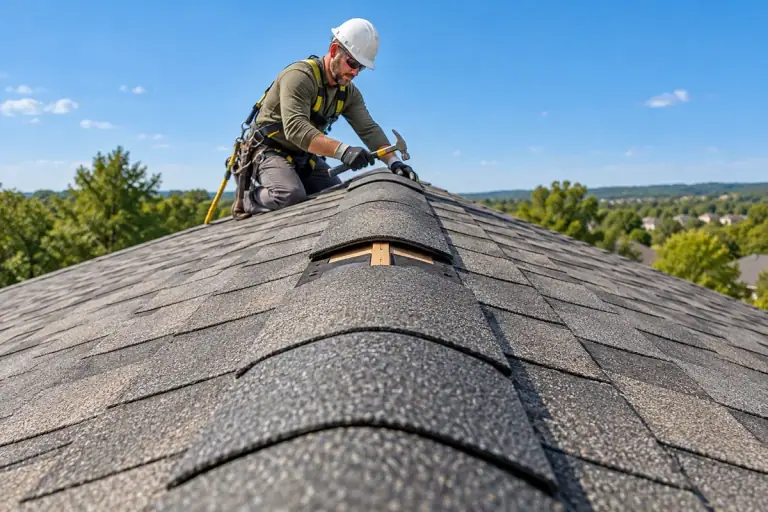
A view along the roof peak showing the ridge caps and a worker attending to a damaged section.
AI-generated illustrations, not photos of listed contractors or completed SkyCrest projects. Images do not establish local service coverage.
Signs of Damaged or Missing Ridge Caps
- Missing or lifted pieces along the roof ridge
- Visible ridge damage after a weather event
- Moisture concerns associated with the highest roof junction
What a Ridge Cap Repair May Include
- Assess ridge covering, attachment, and adjacent roof material
- Check an existing ridge vent where applicable
- Discuss compatible replacement components and the repair boundary
Repair the Caps Without Overlooking the Ridge Vent
A ridge cap is not necessarily interchangeable with a standard field shingle or other roof component. Ask what product is suitable for the roof, how it will be fastened, and whether the ridge ventilation detail will be preserved or repaired. Describe the visible concern from the ground rather than attempting to inspect the ridge yourself.
What Affects Ridge Cap Repair Costs?
- The length and location of the affected ridge
- Compatible cap products and existing roof condition
- Ridge vent or adjacent covering work
- Roof height, pitch and safe access
Pricing depends on the assessed work and the independent contractor. Confirm any assessment charges, written scope, exclusions and payment terms before arranging a visit or approving repairs.
Questions to Ask Before Hiring
- Are the proposed caps compatible with the existing roof?
- Does the ridge vent also need attention?
- How much of the ridge should be repaired?
Planning Ridge Cap Repair
Ridge cap repair concerns the roof covering at the peak where roof slopes meet. The assessment should distinguish damaged cap material from a ventilation component, nearby roof damage or a wider roof-system issue. Ask whether a localized repair is suitable and which surrounding components are included before agreeing to the work.
Identify the Concern From a Safe Viewing Position
Tell the contractor whether you noticed missing pieces, an uneven roof peak, debris on the ground or moisture indoors. Describe when the change appeared and whether recent work or a weather event preceded it. A distant view may show that the roofline looks different without revealing which component is affected. Do not climb onto the roof to confirm a suspicion or attempt to secure loose pieces yourself. Share safely obtained photographs and earlier records if available. Ask whether the assessor can inspect the peak and adjacent material, and what access limitations may affect the initial assessment. Your observations frame the enquiry but do not establish a diagnosis.
Separate the Ridge Covering From Ventilation
A roof peak may include cap material and, depending on the roof, a ventilation arrangement. Ask the assessor to identify what exists at your property and which component needs work. Repairing the covering should not automatically be presented as correcting the home's entire ventilation system. Likewise, a damaged or altered vent detail may require more than replacing visible cap pieces. Request a plain explanation of the connection between the proposed work and the observed condition. If ventilation changes are recommended, ask for the assessment supporting them and how other relevant components were considered. Keep broader system recommendations distinct from the original request for an isolated peak repair.
Determine Whether Damage Is Isolated or Repeated
Ask what the assessment shows about the repair boundary and the surrounding roof. One affected section may support a localized scope; repeated losses or extensive deterioration can raise different questions. The contractor should explain why it recommends a particular length or area of replacement rather than relying only on the number of pieces visible from the ground. Share whether similar material has been repaired before, when that occurred and what was done. A repeated symptom does not prove a particular installation defect, but it gives the assessor a reason to examine the history. Request evidence for any recommendation that expands the work into a larger roof project.
Choose Compatible Replacement Material
Ask the contractor to identify the proposed cap product and its relationship to the existing roof covering. Product availability, installation requirements and the condition of adjacent material should be considered before appearance alone. A close color match does not establish that a replacement component is suitable. Discuss whether the original product is available and what difference in appearance you should expect if a substitute is proposed. Confirm the agreed material in writing so a later change is not mistaken for the original selection. If the roof has a metal or tile peak detail rather than a shingle cap, the recommendation should be specific to that system.
Discuss Adjacent Work and Hidden Conditions
Ask whether reaching the damaged peak requires lifting or replacing nearby covering and whether the proposal assumes that material can be reused. Discuss any supporting repairs that may become apparent only after affected components are removed. The contractor should explain the change-approval process before additional work is carried out. If a ventilation detail is part of the junction, identify whether it is retained, repaired or replaced and why. Do not assume a small visible defect means every underlying component is intact. Equally, concealed damage should not be treated as a certainty before inspection. Written assumptions help you understand both the initial scope and possible changes.
Compare Temporary Protection With the Final Repair
If the assessed condition calls for an interim measure, ask exactly what it addresses and what remains to be done. Temporary protection should have a defined role rather than be confused with the agreed final repair. Discuss access conditions and availability without assuming same-day service or a particular response time is offered. If weather or material supply interrupts the work, ask how the contractor plans to leave the affected area protected and when the next step will be confirmed. Avoid going onto the roof to improvise an interim repair. Arrange access and protective work with an appropriate professional and keep the scope of each stage clear.
Check What the Price Actually Includes
Compare the length or area included, replacement product, nearby work, access arrangements, disposal and completion record. A proposal for a few visible pieces may not have the same scope as one that includes a connected ventilation component or supporting repair. Ask whether the final price includes all agreed stages and how extra findings will be priced and approved. Confirm any assessment charge directly with the independent contractor. If the repair follows an insurance enquiry, keep the contractor's work recommendation separate from the insurer's coverage decision. SkyCrest Roofing does not set the contractor's price or decide whether a policy pays for the roof work.
Use Completion Records to Understand Later Changes
Ask for the installed product details and photographs where practical, then keep them with the assessment and written proposal. Find out which workmanship terms apply and how to report a concern. If another section changes later, the record helps distinguish the repaired boundary from material outside it. Do not assume a warranty for a defined repair covers every future roof issue. Discuss suitable follow-up with the contractor and observe only from safe locations. Where the original concern involved indoor moisture, retain the symptom history as well as images of the roof peak. A repair record is useful even when the finished cap looks similar to the surrounding covering.
Keep the Next Step Focused on the Right Service
Use ridge cap repair when the known concern is at the roof peak. If you only know that water is appearing indoors, a leak assessment may be the better starting point because the source remains uncertain. If the covering is deteriorated across several slopes, the replacement guide may help compare a broader recommendation. These services can overlap at one property, but the contractor should explain one coherent proposal rather than charge for unclear labels. Tell SkyCrest Roofing the city and state, the roof concern and your preferred timeline. Confirm that an independent contractor is available and can assess the actual roof system before arranging an appointment.
Further Reading
These independent educational references are not endorsements of SkyCrest Roofing or evidence of contractor coverage. This guide is general homeowner information, not a diagnosis or a contractor's written proposal.
Ridge Cap Repair FAQs
Are ridge caps and ridge vents the same component?
No. Caps form part of the covering, while a ridge vent is a ventilation component found on some roofs. A repair should identify whether one or both need attention and preserve the intended system details.
Can a standard shingle replace a ridge cap?
Do not assume it is interchangeable. The suitable product and installation approach depend on the roofing system and manufacturer instructions. Ask the contractor to identify the replacement component included in the scope.
Does ridge cap damage mean the whole roof needs replacement?
Not necessarily. A limited ridge repair may be appropriate when the surrounding roof is usable. The contractor should assess the extent of damage and explain whether broader work is needed.
Request Ridge Cap Repair Availability
Share your property city and state, local area and roof concern with SkyCrest Roofing. Call the number in the header or footer to discuss your property. Contractor availability, assessment charges and work arrangements must be confirmed separately.
This is general roofing information, not an inspection or diagnosis of your property. The selected contractor should assess the roof before recommending work.
Related Roofing Services
Discuss your roof by phone
Call to discuss your roofing concern and confirm contractor availability for your property.
- Roofing service
- Ridge Cap Repair
Have these details ready
- Your property city, state and local area
- The roof material and visible concern, if known
- When you noticed the issue and your preferred timeline
Confirm assessment charges and work arrangements with the independent contractor. A call does not guarantee an appointment or coverage.